Friday, August 28, 2015

Going to a Christian College Turned me into a Heathen, Part Four: Panic at the Disorder

If you haven't read parts one, two, and three, go do that first.
--------------------

By the summer before Senior year, everything seemed to be going well. I was set to graduate pretty close to on time, so long as I didn't fail anything. I was getting in shape - I had given up sugar, become a vegetarian, and started doing yoga. I was in what I thought was a happy relationship. I was one year away from finally being able to escape my family for good.

Then I found out Brunhilda wouldn't be coming back. She couldn't swing the tuition payments, and had found an equally good program at her local college - for a quarter of the price. While that did suck, it would work out alright. I would just have the apartment to myself.

I started off the year fairly well. My classes, while difficult, were at least somewhat interesting, for the most part. All my friends were still there, except Brunhilda. I was very active in the gaming club. Life, while not necessarily easy, was still good. Until it wasn't.

November 1, 2013. Opening night of the movie version of "Ender's Game," my favorite book of all time. I had class in the morning, but I drove all afternoon to get home in time to take my sister to see it with me at the movie theater that night. I made it just in time to pick her up, drive the 30 minutes to the nearest theater, and get tickets and popcorn. We sat down just as the previews started rolling.

In the darkened theater, I watched as the characters I had so grown to love were, at last, brought to life on the big screen. It was magical. I was on the edge of my seat, even before the movie started.

Then, about halfway through the movie, I felt a twinge of pain in the back of my head. I thought nothing of it. Until seconds later my heart started pounding out of my chest. My head started swimming, and my fingers and toes started going numb. I immediately started focusing on controlling my breathing - in, out, in, out. I was pretty sure I was having a heart attack. Not wanting to alarm my sister, I sat through the entire second half of the movie in this state. When it finally ended and we stepped out of the theater, I finally told my sister, "We need to call mom to pick us up. I can't drive, something is very, very wrong with me." It was the single most traumatic experience of my entire life.

I found out later, this was the first of what would be many, many panic attacks.

My second panic attack occurred exactly a week later. I wasn't feeling good all morning and when I went to lunch, I stood to take my tray up, and my stomach dropped. My heart started racing, and my head started spinning and all I could do was call public safety to escort me to the campus nurse. I couldn't even form complete sentences. I ended up waiting three hours in the nurse's office for my mom to drive all the way from my hometown to the school to pick me up.

She took me to the emergency room, where they put me on an EKG, did a blood test, and told me there really wasn't anything wrong with me, and it was just a panic attack. They gave me a shot of Ativan, and sent me home. 

I spent that weekend back home and went to see my doctor the following Monday. After a brief examination, and listening to all my symptoms, she diagnosed me with a panic disorder. She prescribed citalopram, the first and last psych drug I would ever - and will ever - take.

You know those side effects you hear about in every medication commercial? The ones they only have to list on the one-in-a-trillion chance that you'll actually get them, but no one ever does?

I got every. Single. One.

Extreme anxiety. Severe depression. Suicidal thoughts. Debilitating paranoia. Nightmares. Nausea. Headaches. Insomnia. Loss of appetite. Loss of motivation. Loss of libido. Weight fluctuation. Difficulty concentrating. If it was printed in tiny type on the side of the bottle, right next to "take with water," and "FDA approved," it was my reality.

I lasted a month. When I ran out of pills, I went back to my doctor and told her I wanted off. She agreed. Normally, she would have weaned me off slowly, but she gave me permission to quit cold-turkey, since I was already on the lowest prescribable dose.

By the end of the semester, I was failing half my classes. I wasn't sleeping. I wasn't eating. I spent all day holed up in my room fighting to convince myself to even go to class anymore. Ultimately, I decided it was time to leave. I was done with Olivet and all its oppressive rules and self-imposed isolation. The Friday before finals, I packed up most of my things and took them home. I was such a mess, I couldn't even bring myself to go back for finals week. I arranged with my professors to do them all in one day, my dad drove me up and packed up the rest of my things, and then I turned in my key and walked away from the campus that had been my home for the last three and a half years.

I slept on my parents floor for the first two weeks I was home. I had such horrific paranoia, I would go to sleep at night one-hundred-percent convinced I was not going to wake up the next morning. After that, I moved to my sisters' floor. They treated it more like a fun sister-sleepover than a fully grown 22-year-old woman who can't handle sleeping alone. I was grateful. I wasn't ready for them to know just how serious it was. I did this for another two weeks.

The first night I slept alone, I woke out of a dead sleep to a panic attack. I threw up. I called my mother's cell phone from the bathroom, too weak and anxious and nauseous to walk the three rooms away.

Throughout this endeavor, one thing remained constant: my parents' insistence that this would all be over if I would just dive back into Jesus. It was the all-too-common Christian belief that any form of mental illness is just the result of something in your life that needs to "get right with God." If I was anxious, it wasn't because of a chemical imbalance or PTSD, it was because I didn't trust Jesus enough. Panic attacks were the result of a failure to pray or read my bible or do my daily devotions. Depression and lack of motivation meant I wasn't seeking God's will for my life seriously enough.

For a time, I tried. I tried as hard as I could. I cracked open my old student bible. I bought devotionals and christian self-help books and went to church with my family and prayed and prayed and prayed. I clung as hard as I could to that old rugged cross, pressing my fingers into the splinters and soaking it with my tears. Hoping against hope that this time, if I tried hard enough, if I was good enough, maybe this time he'd show me mercy and end my suffering.

And every time, it failed. Every day, I watched my hopes drain away, crushed by the reality of chemical imbalances and traumatic experiences and attack after attack after attack. And every time, I felt like a failure. Translating mental illness into spiritual weakness meant that every panic attack was a sign that I wasn't good enough. Every sleepless night was catastrophic failure at making myself worthy of mercy. I fell deeper and deeper into debilitating depression, believing that if I tried hard enough I would be cured, but knowing at my core that I was tired of trying. So very, very tired.

This wasn't the way mercy was supposed to work, I thought. Mercy is not something that you work for, something that you earn if you just try hard enough, if you're good enough, if you prove yourself worthy. It is, by definition, something that is given exclusively to the unworthy. This, for me, was the beginning of a radical change of faith. A faith in which I am accepted as I am, because God loves me, not because I was the best Christian. A faith that says, "you are worthy," even when you fuck up. A faith that says, "your opinions and interpretations are valid, even if others disagree."

I couldn't talk to my parents about any of this, of course. Every time I had a panic attack, my parents would, at first, tell me I needed to trust in Jesus more. After a while, they started denying them entirely, basically telling me I was making them up, coming up with every other possible explanation. Muscle spasms, adrenaline rushes, low blood sugar, anything even remotely connected to my symptoms. Sure, it may have started as any one of those, but my PTSD meant that if I thought I was having a panic attack, I did, whether I already was or not.

But over and over and over I was told to pray, to read my bible, to study my devotions. How could I tell them it wasn't working? My mother was, and is, the patron saint of piety. If there is anyone who could be healed on faith alone, it is that woman. My father, on the other hand, wanted me to just suck it up and move on. It's just a panic attack. Everyone has them. It's not a big deal. You're fine. Shake it off.

This all put a great deal of strain on my relationship with George, as well, especially with him living in Pittsburgh during the semester, and Spain with his family during breaks. He didn't know how to help me. I didn't know how to help myself, for that matter. We got in several fights over the course of that month. For us, I think, this was the beginning of the end.

That spring, I enrolled at Sauk Valley Community College, about a twenty minute drive from home. I changed my major to theatre and enrolled in a few classes, just enough to be full time, with the intention of transferring to Western Illinois University in the fall, where I could live with my grandmother and finish my degree.

It was there that I met my husband.

[Continued in Part Five]

Friday, August 21, 2015

Going to a Christian College Turned me into a Heathen, Part Three: Into the Dungeons (and Dragons) of Hell

Before you read this, you should check out parts one and two.
--------------------

Brunhilda and I became closer and closer as freshman year wore on. That doesn't mean, however, that we didn't make other friends. Quite to the contrary, in fact. We had a very close-knit group of friends that consisted primarily of people we met in our honors class. There was Doris*, Boris*, Freddy*, and Cape Guy**.

By the end of the year, Cape Guy would become my very first GM.

"What's a GM?" you say? So glad you asked.

GM stands for GameMaster. It's the person who tells the story and directs the action in a tabletop roleplaying game (RPG), such as Dungeons and Dragons. If there's one thing that makes a conservative, fundamentalist Christian mother clutch her metaphorical pearls, it's Dungeons and Dragons. So, naturally, I did not tell my parents I was becoming involved in this, the most heathenly of social activities short of an orgy. 

In secret, I excitedly created my very first character, Navi, a Pixie Seeker/Healer. I rolled up her stats, carefully crafted her backstory, and even bribed Cape Guy into letting her have an extra ability in which she could poke people with a sneak attack for 1d4 of non-lethal damage, which I called the Pixie Poke of Contempt.

Our game consisted of myself, Brunhilda, Cape Guy, and his roommate, Burt*. Since Cape Guy was the only veteran of the group, he was the GM, of course, and he took things fairly slow for the rest of us, the playing characters. I don't remember much about that game, since it only lasted a few sessions, but it remains an important part of this story - this was the game that got me hooked on gaming.

Sophomore year was a dry year for gaming. It was an eventful year for other things, as Brunhilda and Cape Guy ended up in a cataclysmic fight, which dissolved their friendship entirely for about 2 years, and split our friend group in two - Brunhilda and myself, and what we referred to as "the cult of Cape Guy." Meanwhile, Brunhilda and Burt ended up dating second semester, and got engaged over the summer. ("Ring by Spring," anyone?)

Junior year, Brunhilda and I joined another RPG, this time run by my "big brother," Merlin***, who is a year younger than me, and in no way, shape, or form related to me or anyone in my extended family. I revived Navi, now with a last name - Alistair - and some minor adjustments to accommodate a different version of the game. Our fellow players, who to this day we refer to as "the party," included Doma, The Paladin, The Cleric, Batman, and briefly, Squirrel. These were my best friends for the next year and a half (and even now, although it's more difficult to stay in touch these days).

There's something about slaying an army of Kobolds that really brings people together.

Junior year also became what Brunhilda and I lovingly - and secretly - referred to as the "Year of the Slut." While she was engaged to Burt, and I was in a very serious relationship with George, both of us were finding ourselves unmistakably attracted to other people. We both, for a while, believed that somehow this wasn't an indicator of a serious relationship flaw, which would lead to our eventual breakups, but eventually the truth would become clear. For her, this clarity came in the form of The Paladin. Oh, at first, they were just messing around as "friends with benefits," since Burt had graduated and wasn't really around much at all. Leaving a very lonely Brunhilda behind at Olivet. What started as "innocent friendship," however, became a very serious romantic tryst. By second semester, Brunhilda had started finalizing wedding plans with Burt, and realized, not a moment too soon, she was not in love with him. Brunhilda and The Paladin finally dated, officially, for about 6 months.

My moment of clarity would come much later, but we'll get to that. Trust me, we'll get to that.

Meanwhile, second semester of Junior year, Olivet finally sanctioned a tabletop gaming club. Many of The Party were among the founding members, along with several friends with whom Brunhilda and I had begun playing the popular trading card game, Magic: The Gathering. The Tabletop Gaming Club was not just for heathen games like Magic and D&D, of course. Any game which could be played on a tabletop was heartily welcomed. Card games, board games, RPG's, party games, anything you could think of, except video games (so long as it was "Olivet Appropriate," of course). This was the beginning of my mad descent into the world of tabletop gaming.

While I was happy to join in any game I could, my favorite had become Magic: The Gathering. It's a card game wherein you build a deck out of collectible cards, in order to play as a Planeswalker and cast spells and play creatures against your opponent(s) in order to attack them and bring their life totals down to zero. Naturally, my mother hated it.

I did make the mistake of trying to introduce my family to it. I thought, perhaps, since it's just a card game, not an RPG in which you pretend you are the character, perhaps my mother wouldn't see it as quite so satanistic. I was wrong. I was forbidden from teaching the game to my sisters, and when I brought my cards home over the summer, I wasn't allowed to take them out of my room. I should have known better, obviously, since I was one of those kids who wasn't allowed to read Harry Potter because there's magic in it, and magic is of the devil.

This is when I truly started to become my own person, with ideas and beliefs different from my family's. My inner heathen was growing rapidly. And then, it all came crashing down.

[Continued in Part Four]

--------------------
*Names have been changed for privacy.
**Name has not, in fact, been changed. People legitimately called him "Cape Guy."
***Again, he actually goes by Merlin. Which, incidentally, is a name I gave him when we first met.

Friday, August 14, 2015

Going to a Christian College Turned me into a Heathen, Part Two: Sex, Drugs, and Rock & Roll

If you haven't read Part One yet, go read it now. It's cool. I'll wait.
--------------------

My first roommate was Kelly*. She was in ROTC. She got suspended first semester for going to a party where there was alcohol. Enough about Kelly.

Because this part of the story isn't about Kelly. Kelly doesn't count. This is about my real college roommate. Brunhilda*.

I first met Brunhilda at orientation. She was an introverted girl hiding in the back corner of the cafeteria. I was an agressively friendly extrovert seeking out people who didn't already have friends. It was love/hate at first sight. I take great pride in the fact that when we first met, I scared her. Because from then on, it was the other way around.

Brunhilda was the kind of person who jokes about becoming a serial killer, and you honestly aren't sure she's joking. And, of course, she was a nursing major.

This, obviously, made her the ideal candidate for my best friend.

We moved in together the last few weeks of first semester. Kelly had practically moved out, Brunhilda's didn't get along well with her previous roommate, it seemed perfect. So, we packed up my room, shoved it all 5 doors down the hall, and started a friendship that would last our entire college career and beyond.

Now, Brunhilda didn't come from quite as conservative a background as mine, although she certainly didn't come from some progressive hippie house. Her family was only slightly less conservative than mine, but somehow, she was far bolder and more progressive than me already. I blame this, in part, in the emotional abuse I'd unknowingly received from my father, training me never to question his - and subsequently anyone else's - authority. Brunhilda became the Honest John to my Pinocchio, leading me off to the "pleasure island" of sex, drugs, and rock & roll. Despite being introverted, she had a very strong personality that both appealed to me and ultimately began to rub off on me. Now, before you accuse me of succumbing to peer pressure or anything, the reason her personality rubbed off on me so easily is not because of the stereotypical "if your friends jumped off a bridge" nature of young adults, but because here was the type of bold, empowered individual I'd always secretly dreamed of becoming, but had never dared.

In October, I started dating George*. This was my first real relationship, and my first boyfriend since freshman year of high school. George and I had started as close friends for my last two years of high school, and had been leaning toward something more for quite some time, so when, two months into my freshman year at Olivet, he confessed to me that he loved me, I was elated. Although it was a long-distance relationship - he was two years younger than me, and so was still finishing high school back in my hometown - we began chatting every night. It was bliss.

When I was twelve, I decided I was going to save my first kiss for my wedding day, and I think it's a pretty serious indicator of the kind of family I grew up in that my parents took this 12-year-old vow seriously. At the age of twelve, I had barely started puberty, but somehow this qualified me to make sweeping sexual declarations, and my parents expected me to follow through, even long after I had realized how unreasonable a goal it had become. It went from joking around the dinner table to a very serious expectation - one that, should I renege, would break my poor mother's heart.

It is for this reason, I remember waltzing, smugly, into my room after a long weekend home, during which I had received my first kiss, as if kissing a boy at the ripe young age of nineteen was somehow a secret, taboo sort of behavior, the kind of bold activity that would create scandals and shock my peers. I remember excited late-night whispers, as I regaled the tale of my very first sexual experience with a boy.

I remember the kiss itself, too. Riddled with guilt and shame. How dare I desire to share something so sacred with a mere boyfriend? Nevermind that it started as an accident - I had gone to kiss his cheek and missed (he confessed to me later that was a lie. I was not angry. I had already known.) - I was tainted goods now. I was so ashamed it took me a full year and a half to finally tell my mother. Another month after that to tell my father.

It was in telling Brunhilda about it, however, just days after the initial event, that caused me to start to think, perhaps this is not so monumentally shameful as I thought. After all, people had been kissing boyfriends for ages, and somehow the entire institution of marriage had not crumbled beneath a sea of infidelity. Between Brunhilda and George, somehow, I began to accept my sexuality as a normal thing. This was the first step to becoming a heathen. Now, I was sexually active.

Now, the funny thing about shaming people into behaving a certain way is that, when they do finally break the rules and realize how not-guilty they feel, it leads to a long thought process of questioning everything you've ever told them. This is the true nature of the "slippery slope of sexual immorality." A combination of painfully repressed sexual curiosity, coupled with the sudden realization that everything you've ever known might potentially be a lie, leads fairly quickly from first kiss to first makeout to first grope to first blowjob. It still takes time, but ultimately, curiosity gets the best of you.

The truth is, sexuality is normal, and when you make it taboo, as my parents had done, all you do is make it sexier. Everyone wants what they can't have, and when you glorify it into some exceedingly desirable, but strictly forbidden fruit, it makes it all the more delicious, and all the more impossible to resist, so that when you finally do give in, it's not in small bites - you eat the whole damned thing.

You know, it's a funny thing, becoming a heathen. It never happens slowly. It always seems to happen all at once. Because when you're already going to hell, why not go further?

[Continued in Part Three]

--------------------
*Names have been changed for privacy.

Thursday, August 13, 2015

Freedom Hair

Today, I did something drastic. Something brave. Something extraordinary.

Today, I dyed my hair turquoise and green.

It's the first time in my life I've ever dyed all of my hair a crazy color. One more item off the bucket list. And it felt like freedom.

As kid, and even as a teen/young adult, I was never allowed to dye my hair. It was "unnatural." As my mother put it, "If God meant for you to have [insert color] hair, he would have given it to you." Even once I got into college, it took everything I had to work up the courage to dye my bangs red. I remember hiding it under a scarf for a mother-daughter luncheon shortly after it was first done.

So, tonight, as I worked color in, one glob at a time, as I watched my hair transcend from dark brown to golden honey to bright aqua and electric lime, as I pressed the colors into each strand, careful to saturate every inch, I felt myself becoming more and more free. More and more the manic pixie I've always wanted to be.

Tonight, I realized, the colors I chose are symbolic, whether I realized it or not. The shining aqua and green have come to symbolize freedom to me. These colors are not only the first unnatural colors I've put in my hair - they are so much more.

They are the Wicked Witch of the West, the first time my parents allowed me to do something magic-related, and the role for which I won Best Actress my senior year of high school. They are my sheets and blankets my first night away at college, finally starting to escape the hold of my family. They are my first D&D character, a pixie named Navi, who lives in a forest. They are the christmas lights I hung around my bunk to scare away the anxiety when I was diagnosed with a panic disorder. They are the journal I sobbed into when I realized what my parents had done to me. They are the sky above, and the ground below, and all the infinities in between.

And they were our wedding colors. They were my bouquet, as I walked down the aisle toward the love of my life. They were my father's eyes, as he gave his blessing - not gave me away, as if I were his property. They were my husband's vest and tie, as we held scraps of paper with trembling fingers and tried to speak our vows, rather than sob them. They were the reflection of the altar in the silver rings we exchanged. They were the foil stars hanging from the ceiling, and the cheap plastic tablecloths spread under pizza. They were the striped napkins, and the paper streamers, and the amazing cake made by my mother in law, and everything that made that wedding perfect.

Because somehow, in binding myself to my husband, for the first time, I became free. No longer was I my father's property, bound to do as he commanded. "My house, my rules." Despite assurances that in my future biblical marriage, I was to submit to my husband, I found myself eternally bound to one who calls himself "partner,"rather than "master," and I could not be more grateful.

So, tonight, as the color dripped from my hair, soaking the shower floor in broken hearts and broken promises, long lost to time, I embraced this freedom. I dried my newly colored locks, opened wide the bathroom door, and was heartily embraced by a husband who loves me, with a silly grin on my face, and freedom colors in my hair.

Friday, August 7, 2015

Going to a Christian College Turned me into a Heathen, Part One: The Cool Kids

Let me tell you a story.

I grew up in a conservative fundamentalist Christian home. I was the perfect child. When I graduated high school, I came out 11th in my class out of 188, had straight A's, took 3 AP classes and passed the exams for every one, and had never kissed a boy. I was accepted into both colleges to which I applied: Milikin University, and Olivet Nazarene University. Both were much closer to home than I would have liked, but seemed nice, and were offering large scholarships - the biggest stipulation in my future college career.

Ultimately, mostly due to my parents' influence, I chose the nice, conservative Chrisitan school, which promised a beautiful campus, prayer and devotions at the beginning of every class, chapel services twice weekly, an on-campus church, and the kind of fundamental God-centered environment you can only create with strict Bible-based rules and a community of shy, mostly homeschooled "good-kids" who wouldn't dare break them.

This is the story of how that environment turned me into the heathen I am today.

I started at Olivet in the Fall of 2010, two and a half months after graduating high school. I chose to study music - another area into which I was pushed by my parents, both music majors, themselves - with a concentration in Composition. I was going to write musicals.

As a music major, and with 8 years experience playing flute, it's only natural that I ended up in the Olivet Marching Tigers - the university marching band, one of the largest in the state. This meant arriving on campus a full two weeks before anyone else - making move-in deceptively easy with no other freshmen to trip over. Living in the Freshman Girls' dorm meant that I got to move into my room right away, rather than having to wait a week for the Bears to move out of the rest of them.

Oh, yes. The Bears. As in the Chicago Bears. The football team. Who held their training camp at Olivet every year, cutting into the first week of camp. Whose presence created such massive traffic jams that it became unreasonable to make a brief trip to the Walmart just two miles from campus during our hour-long lunch breaks, because you would never make it back in time. And who were apparently so in fear that I would stab them to death with my flute that for one week every year, I wasn't allowed to walk through the quad in the middle of campus, venture any further than my own dormitory, or even park anywhere other than the practice field parking lot - 6 blocks off of campus. I had to wear a security badge just to get lunch in the cafeteria or walk into my dorm.

I hate the Bears.

But, I digress.

Band camp, for those of you who have never been, is not the wild orgy-fest you see in movies (not even at a party school. I've been to one of those too. I'll get to that later.) What it is is two weeks of sweaty, exhausting, sunburnt hell...

...And still, somehow, the best time of your life.

Now, the experience at a community-based college like Olivet is a little different from a state university, as I discovered, but the principle is the same. You spend a week learning and re-learning all the basic marching techniques you've somehow un-learnt over the last 9 months, followed by a week of putting drill chart after drill chart onto the field in an effort to be ready to march an actual show during the halftime of the first game of the season, which unwaveringly takes place the very first weekend of classes. Because it's not like you had anything to do that weekend, anyway.

Evenings at Band Camp at Olivet were a lot like a youth group or VBS - the band was broken into randomized teams (to encourage inter-sectional friendships, something you don't see at state schools), and then competed in camp-style games like eating contests, trivia matches, or physical stunts, to earn points toward a pizza party at the end of camp. Each day of camp featured a theme, such as "twin day," "fantasy day," or "dress like the professor day," (there was always a "dress like the professor day.) for which everyone came to rehearsal - both on and off the field - in full (probably painstakingly homemade) costume. Believe what you will about band geeks, but we're the real cool kids.

It was in the midst of these blissful, hellish weeks that the first rule violations of the year always took place.

Now, of course, what happens at band camp stays at band camp, so most of these violations went unreported and thus unpunished. It always started small - dress code violations in the form of tank tops and short shorts, an effort to keep somewhat cool while marching in 105 degree full-force afternoon sunshine. From there, it moved to things like letting guys into the girls' dorm - mostly to help move heavy wood furniture, but a violation nonetheless. Perhaps the occasional curfew was broken in favor of finally making it to Walmart for sunscreen or ramen or a lamp or whatever else it was you desperately needed. For the most part, all tame, innocent violations. Sure, you heard the occasional story of seniors going out for a drink (Olivet is a 100% dry, zero-tolerance campus. You can get suspended for throwing away someone else's beer can that you found on the street.), and once I heard tell of a brass player actually getting laid on campus during camp (scandalous!), but for the most part, we were a tame bunch.

And then, school starts. Campus explodes with life. Students arrive in a frenzy of coordinated bedding and mile-high cardboard boxes.

This is where the fun begins.

See, although a fundamentalist Christian school like Olivet promises a wholesome, God-centered, strictly enforced environment, the outcome is far different from expectation. Because what happens when you get an entire campus of repressed, latently-rebellious, formerly-fundamentalist, newly-minted adults, getting their first taste of freedom, ironically, is that all hell breaks loose - in a rather literal sense.

These fresh grown-ups with all their new responsibility and stunted rebellion are not looking at these new, strict "community guidelines" as a way of life, they're looking at them as an infringement on the first taste of freedom they've probably ever had. So, rather than obediently follow them to the letter, we found loopholes. And if there's one thing Christians love, it's loopholes.

And my, did we get creative. If there was a way around something, we found it. Figuring out ways to get around the rules is what the cool kids did on weekends -  mostly because there wasn't anything else to do. Entire cafeteria discussions revolved around how to bypass the oppressive system of violations and fines (Olivet has an obsession with fining people. Because our $40,000 tuition wasn't enough for them.).

My friends and I got around the rules against swearing by coming up with alternative swear words, or swearing in foreign languages. Our policy was, "If Dr. Bowling (university president) can't understand it, you can't fine us for it." Marching band became a constant excuse for dress code violations. "But it's too hot," we'd protest, pleading with RA's to forgive us the crime of wearing shorts before 4:30. It was never anything major, never enough to draw attention. Just enough to get by, to regain a few personal freedoms.

Now, of course, there were those who did follow the rules and saw no need to embrace their newfound freedoms, and there was a clear divide between us - the "sinners" - and them - the "saints." In fact, there was a literal divide, since the cafeteria was split into two sides, which frequently split the two camps evenly. These people were the pastors' kids who grew up to become pastors themselves, the shy, homeschooled masses, who had never seen an R-rated movie, read a fantasy book, or taken a sex-ed class. By senior year, many of them would convert to "sinner" status, but there were the precious few who made it out unscathed. I was not one of them.

Upon arrival at Olivet, I immediately embraced my freedom, taking the opportunity to finally make decisions for myself - something I had never been allowed to do at home. For once, I had a choice: which bedsheets to buy, what classes to take, whether I could eat nothing but ice cream for dinner (yes, I could, and did), and - the decision that would change everything - who to live with. It is in this way, I ended up, by the second semester of my freshman year, living with my best friend, and now, roommate. And so it begins.

[Continued in Part Two.]

Monday, March 30, 2015

Loss and Flight and a Broken Kite

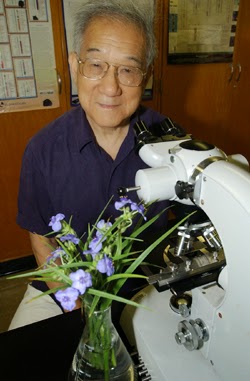
Last night, the world lost a great man, as my grandfather, Dr. Te Hsiu Ma, passed away in his sleep. He was 90 years old.

He was born August 24th, 1924, in a small village outside of Beijing, China. Twenty years later, he was forced to flee the country, a refugee from the government. He spent the next 60 years of his life becoming a world-renowned scientist and much-beloved professor at Western Illinois University. A gifted biologist and geneticist, he is most well-known for the discovery and development of the Tradescantia Micronucleus Pollution Detection System. He traveled all over the world, demonstrating the incredible abilities of this common wildflower to detect pollution in air, water, and soil.

He married my grandmother, Peggy, in 1959, at a small ceremony attended only by a few friends. Together, they raised four children, my uncles, Lyndon, Lindsey, and Linwood, and my mother, Linette.

He was a loving grandfather to nine grandchildren: 7 biological grandchildren, and 2 step-grandchildren, whom he loved equally much. As the oldest biological grandchild, I was fortunate enough to have spent the most time with him before his passing, and it pains me that my younger cousins will not have many of the memories I have been blessed with. I therefore wish to pass along some of my favorites, both as a tribute to a great man and loving grandfather, and as a way to share these memories with those who will never get to experience them.

I remember the way he used to mispronounce "milk" due to his thick Chinese accent, and how I, as a precocious child, would always correct him, "No, grandpa, it's not moke, it's milk!"

I remember his art studio in the basement, and the playhouse he built for me under his desk out of a very large cardboard box. It had windows and a small door, and I used to play in it for hours, dragging toys in and out, and begging him to join me.

I remember painting with him, watching him put colors on canvases in works of art more precious than I could possibly have understood, with masterful strokes of his beautiful brushes, while I, young and inexperienced, sat nearby with my crayola watercolor palette, oblivious to the presence of a master.

I remember receiving "Letters From Felix," a reference to a popular children's book about a stuffed rabbit who is lost at the airport, and ends up on an international adventure, sending letters to his owner, Sophie. He would write me elaborate stories about a trip to some kind of candy land, and his adventures there, under the nom de plume of Felix the rabbit. Sophie wrote to Felix for the last time this February, after far too many years of letterbox-silence.

I remember traveling with him, stopping at a rest area to stretch and play Frisbee, where a somewhat poorly aimed throw (on my part, of course) resulted in some rather interesting roof-climbing adventures.

I remember flying kites with him in a large field, and I remember the day we learned the hard way to tie the string to the spool, as my beautiful plastic storebought kite soared beyond the reach of its cotton line, and was lost forever in a reservoir.

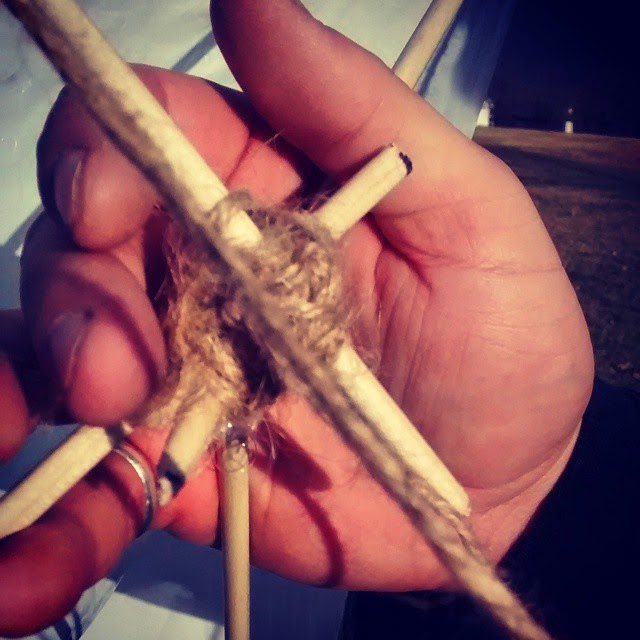
I was reminded of this particular memory yesterday, as I spent the afternoon flying a homemade kite with my fiance. We built the kite in our little apartment out of wooden dowels and fishing line and trash bags and twine. We carried it down the street to the park, the boyish excitement evident on my fiance's face. He had never built a kite before. It was a childhood dream come true.

We struggled to get the kite in the air, trying every possible method for anchoring the twine so as to reduce the kite's penchant for midair-pirouettes, resulting in two separate arguments. As we finally came to a design that might work, the unimaginable happened - the kite broke. The horizontal part of the frame snapped directly in half. I watched, heartbroken, as all of my fiance's childhood dreams came crashing to the ground. Frantically, I pulled the broken pieces together, wrapping layers and layers and layers of twine around the center of the kite, trying to anchor the pieces back together in the frame. I watched my fiance's face light up as he found hope again, and shared in his joy as, by some miracle, the kite was fixed. Quickly, we attached the final anchoring point and lifted the kite into the air in a powerful gust of wind. It didn't fly well, but it flew...

...for about fifteen minutes. After several unsuccessful attempts to achieve flight, and a few incredibly satisfying successful attempts, the kite came crashing down on its head, snapping the vertical dowel in exactly the same place as the horizontal. But we still refused to give up. We shoved the broken pieces back into the messy knot of twine and threw the kite back into the air, believing it could fly like some kind of plastic Peter Pan. And whether it really was faith, trust, and pixie dust, or just some fluke of physics, somehow, that thing still flew. Even after one side of the sail detached and had to be tied back on with leftover twine, it managed to capture the wind and soar into the heavens. It continued to float and spin on the breeze until, finally, we decided it was time to go home. By this time, the kite was an ugly thing, repaired and re-repaired several times, with more twine holding the frame together than anchoring it to the ground.

Yet, when it was in the air, it was glorious. You didn't see the broken frame or the knots of twine or the struggle just to keep it in one piece. You saw a great white sail gliding through a blue-sky sea. It snatched onto the wind's tails and was carried far into the heavens, one gust at a time. It may have been terribly broken, but in the heavens, it soared.

By the end of his life, my grandfather was not a healthy man. He suffered for the better part of a year from dementia and memory loss. By his final days, he had difficulty telling night from day, or remembering if he'd eaten recently. He had to be kept under constant supervision, and was on morphine to keep him comfortable, as inside, his organs began to fail one by one.

But this is not how I choose to remember him. I like to think that as he has left this broken body, his spirit now flies in the heavens, just as our broken kite did. I see him on streets of gold, singing like Pavarotti with the heavenly chorus, and asking God all the questions he never got answers for on earth. I don't see the broken man being held together with bandaids and medication, but a man in his prime, soaring with the angels for eternity.

While I do have many wonderful memories, there are some I will never be able to share with him. He will never see me graduate college. He will never see me finish my book. He will not be there when I walk down the aisle this October. He will never met his great-grandchildren. He will never see my first home, meet my cat, or hear my second album. And while he may witness all these things in spirit, never again can I hug him, or talk with him, or tell him how much he meant to me.

I was supposed to see him next weekend. My fiance and I were going to drive down for Easter. I had plans to bring a kite to fly with him one last time, and to share one last Easter celebration with him. Now, we will most likely be traveling to his funeral. I only hope that I can show adequate respect and appreciation for a man who has shaped more of my life than even I probably know, and who I hope is watching me with pride from his seat at the hand of the creator.

Rest in Peace, Grandpa Te. I love you.

Saturday, March 28, 2015

Making a Mess

Creating is messy.

Tonight, I created a delicious mess. I took down a box of dry devil's food cake mix I thought we would never use, and I made homemade chocolate cake fudge. I buried my hands in warm, gooey chocolate and sugar and butter and milk and pressed together something wonderful from something I thought was useless. The kneading became almost meditative, letting the warmth soak into my body through the tips of my fingers, and the palms of my hands, scraping sticky dough back into the big red mixing bowl, reminding myself that sometimes, we have to make a mess, before we can reap the beautiful creation.

This applies as much to any art as it does to cooking. The mess is what makes the clean, crisp final product all the more satisfying. When we've cleaned our brushes, washed our pans, tuned our guitars, sharpened our pencils, and we can look at a project and say, "it is done," we find ourselves relieved that we have completed our goal, yet somehow, missing the mess.

Creating is undoing.

It forces us to look at our tools, all lined up in a row, and use them, throwing them every which way, undoing all our nice, neat handiwork, inventing a space which is all our own. It looks at our souls and pulls out the deepest, messiest parts of us, unwinding knots and tearing down walls, until all our innards are exposed in page or pan or paint. It expresses that which is inexpressible, and pushes our most vulnerable pieces into the light.

Creating is freeing.

This is the beauty of creation, when we take something that we fear, some secret part of us that we may think is too bitter, or undeserving of love, and we nurture it, feed it, press it and mold it, into something beautiful and delicious, finally sharing the parts of ourselves we love least with those we love most of all.

And for the record, the fudge was amazing.


----------
Cake Fudge Recipe:

1 (~16 oz.) pkg Dry Cake Mix (your choice.)*
2 cups Powdered Sugar
1 stick (1/2 cup) Butter, cut into tablespoon-sized chunks
1/4 cup milk

1. Line an 8x8 pan or baking dish with foil. Grease or spray with non-stick spray.
2. Combine Cake Mix and Sugar in a large mixing bowl. Mix together, and make sure to break down any chunks.
3. Add milk and butter and microwave for 2 minutes.
4. Knead together all ingredients until thoroughly combined. Dough will be thick.
5. Refrigerate 2 hours, or until desired consistency. Store in airtight container.

*My cake mix was 18 oz, and the fudge turned out just fine, with no other changes to the recipe.
Inspired by this cake batter candy recipe. 

Tuesday, March 24, 2015

It Just Has to Be

I am a writer.

I. Am. A. Writer.

The words sit on my tongue, not quite real, not quite solid. It's something I've sort of known all my life, but never actually expressed or embraced. Not until two weeks ago, when I turned to my fiance and said, "I want to write a book."

It's a book that has been in my head for over two years, tugging at my bones, pulling at my heartstrings, begging me, "please, please share me. Pour me onto a page and drink me back in, one word at a time. It doesn't have to be good, it just has to be."

It doesn't have to be good.

It just has to be.

So, in the clutter and chaos of my home, I created a space for creating. Shelves of fantasy books, journals and crayons and pencils and markers and chalk for the chalkboard I made myself out of a pizza pan and spray paint. Cups of tea and sticks of incense and my very own magic wand.

And I wrote.


I am a writer.

Last week, I identified myself as a writer for the first time. I was in a job interview, and the interviewer asked what I do in my spare time, and I answered her, "I play music, and I read... and I'm a writer." It was words that I had never said out loud to anyone, not even myself, and suddenly, saying it to a complete stranger, made it feel very real. I felt a piece of that identity bubble up inside me, warm and gooey and sticky, filling in some of the cracks that had been growing and widening for longer than I can recall. It felt right. "I'm a writer." It legitimized years of literary obsession, of grammatical knowledge, of absorbing everything I could about the nature of words.

I am a writer.

It sits there, so delicate on the tongue, almost like it's scared to peek out and make its way into the world. It hides behind rows of bone, protected from critics and naysayers. It's safe in there, warm and snug, and unaffected by the outside world. No one can call it names like, "lie," or "joke," if it can't hear them through the soft pink walls of its safe house.

But creating has never been a safe venture. Nothing has ever been created that didn't first have to crawl out of its protective shell and stand in total vulnerability before the unforgiving masses. But that's what gives it life. Like a baby can never be born without leaving the womb, so a story can never be born without leaving the tongue. In order to gain life, it must first leave everything it knows behind.

The wallpaper on my writing laptop says, "Whether or not you write well, write bravely." (Bill Stout) Put the words on the page, and go from there.

It doesn't have to be good, it just has to be.

I am a writer.

So, I open my mouth.

Thursday, March 19, 2015

So I Went to A School Board Meeting...

As some of you may know, I'm a News Reporter for three local radio stations in my hometown. Tonight, I went to a school board meeting. After suffering through a 3-hour meeting in which exactly nothing newsworthy happened, I was struggling to come up with a story to send the news director to use tomorrow. To overcome my writer's block, I wrote this. This is the story I wish could go on the air:

[language warning: some swearing.] 
Wednesday night’s School Board meeting was interminably long and unequivocally boring. Nothing happened, no one cared, and even the school principals didn’t want to be there. As such, you, as the listener, definitely don’t care what happened, because if you did, you would have showed up and sat through the entire three-hour-long meeting, most of which was spent discussing budget minutiae and teaching the mostly elderly board how Facebook works. But you and I both know that was a waste of time, so I won’t bore you with the details of the reports from athletic coaches about “he’s going far” and “she’s so talented.” I won’t tell you about the brief appearances of the students of the month, or the board’s feigned interest in “how do you do it?!” or their sheepish responses, smattered with “um” and “well…”
Instead I’ll remind you that regardless of what happened last night, today your child still got up for school, maybe ate some breakfast, left the house in an outfit that odds are you seriously questioned before begrudgingly wondering to yourself what happened to the fashions of your time and sending them on their way with a loaded backpack and a fistful of lunchmoney. They still went to math class and the teacher still managed to simultaneously overexplain a concept and not teach a single student a damn thing about how it actually works. And after the last bell rang, they still went to the same sports practices and study groups, and when it was all said and done, they came home to the same house and the same room and the same bed and tomorrow they’ll do it all over again.
I’ll tell you the only detail of that meeting you care about, which is this: tomorrow, and the next day, and the day after that, your child will still follow this exact same routine, until the day they graduate from high school. As of last night, nothing has changed, and based on previous experience, it never will. Which is why I’m telling you: if you want to know what happened at the school board meeting, go to it yourself. No one else gives a fuck.

Sunday, May 11, 2014

The Day They Stole My Brave

I found my Brave. I finally took hold of it with both hands and pulled as hard as I could. It was mine, bold and shiny and terrifying and free and all mine at last. The Brave I have struggled to claim for as long as I can remember. I took my brave and I packed it in a suitcase and I walked out the door.

And then the chains. How they rattled and clanked. How they pulled and creaked, rusty and stiff from being still for so long. The weight, so unbearable, long-forgotten from years of quiet tolerance. So many hours of nodding and smiling and "mmm hmm" and "nuh uh," just waiting for my wings to sprout and my Brave to come.

I found my Brave. But it wasn't enough. Like so many other parts of me that aren't enough. That will never be "enough." Because as soon as I pulled with my Brave, they pulled back, harder than ever, with heavy chains and thick ropes and overwhelming shame.

They told me it was wrong. That my Brave was evil. That it was carnal and selfish and not Brave at all, but cowardly. They told me I was stupid. That thinking I could be Brave was crazy and idiotic. For the next 3 hours, my Brave, once shiny and bright, was battered and beaten, dragged down, wings broken, and finally thrown into a box and locked away. "You can have it later," they said, but what they really meant was:

     Don't ask.

     Don't try.

     Don't run.

     Don't dare.

     Brave isn't for you. It was never for you. Brave is only for them. The dirty, the unworthy, the sinners.

They spit the words like venom, sour and dark and poisonous, piercing my very soul until I cowered on the floor, broken and bitter and bloody and so, so trapped. They built up their arguments like a cage around my life, my ambition, my future. Squeezing my world into a tiny box of "yes, sir" and "no, ma'am," where you choose logic and money over love and adventure and spontaneity.

They stole my Brave. They took it away and reprimanded me for playing with the big kids' toys. They told me I wasn't old enough, I wasn't ready, I couldn't handle Brave. I could only handle Timid and Obedient. They sent me to my room, the very room I had pulled so hard to escape, and told me to think about what I had done. They clipped my wings with jagged shears and left scars that will never heal properly.

They stole my Brave. Cut it from my chest with words and paper and Angry-Jesus. Spitting scripture like fire just to keep me chained in place. Whatever happened to "my chains are gone, I've been set free?" This isn't freedom. This is house arrest. This is worse than prison. It's the taste of freedom without ever getting the whole bite, the whole plate, the whole dish. There is nothing worse than hope.

They stole my Brave. They said it was never mine to begin with.

But they were wrong.

I'm taking back my Brave. One day at a time. Bit by tiny bit. I'm collecting the pieces. Gluing the feathers back onto my broken wings. I'm cutting the chains, one by one. I'm making my plans, packing my bags, and making my way out that door one toe at a time. I'm getting ready and as soon as I see my opportunity, in the blink of an eye, the flash of a second, I'll be gone. They'll never see me again. I'll be no more than a flicker in the candlelight, a shadow on the windowpane, a whisper in the wind.

Blink. I dare you.